

Hook
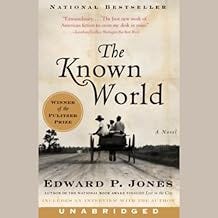
The Known World relates the oddities and peculiarities of America and slavery her old mistress in antebellum Virginia. Guess what, you may be thinking that only whites subjected blacks to slavery, but oddly blacks subjected other blacks to slavery. “Black slave owners owned slaves who were slaves of slaves.
Book Summary
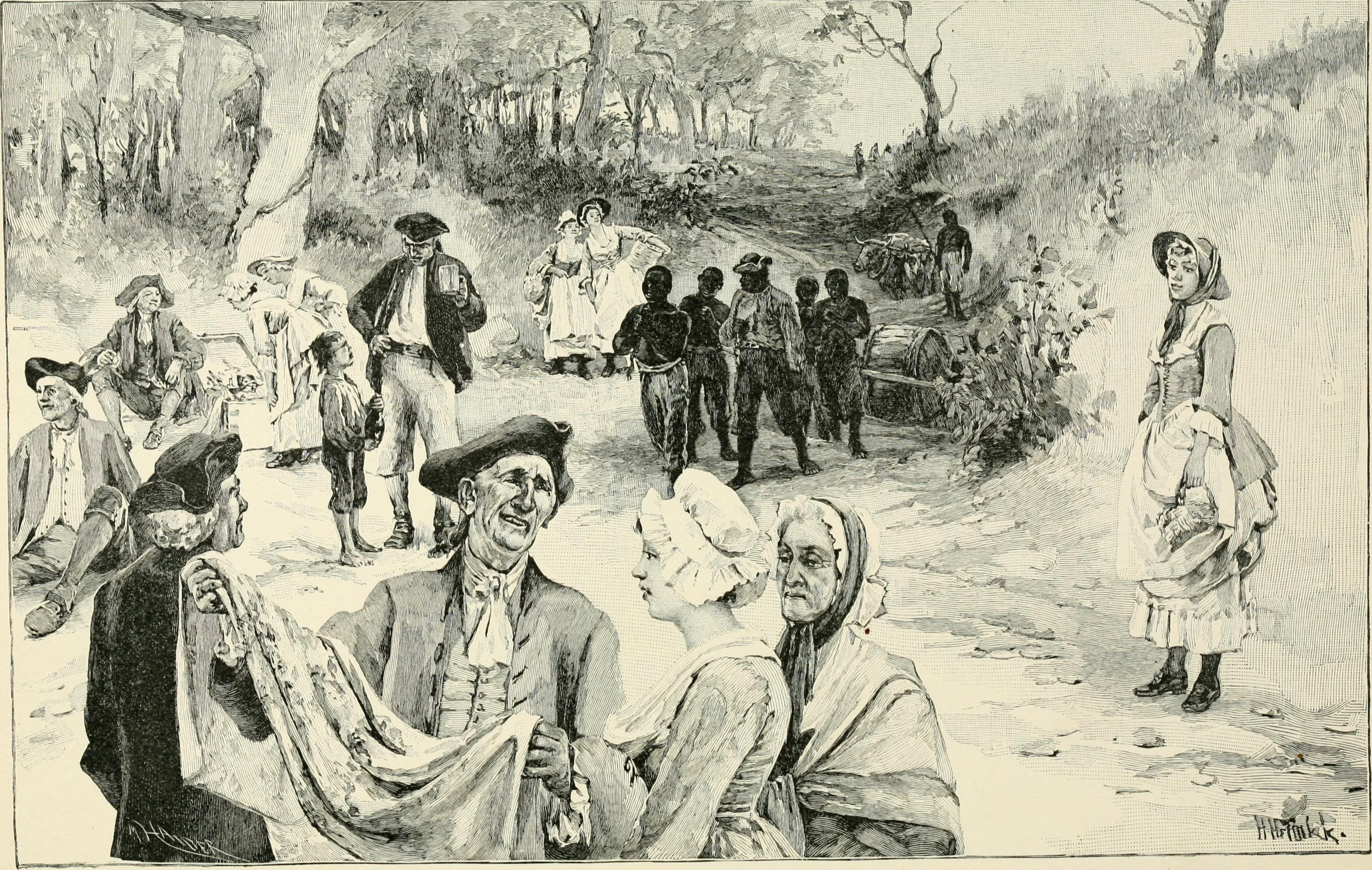
“When the supply ship came in, in Old Virginia days” – Source Wikimedia
The Known World refers to a map brought by a Russian who travelled through Manchester, VA. The map showed for the first time the word America, which had never been put on a map. The land of North America on that map was small. South America was about the right size, but it alone was called America. North America was nameless.
In antebellum Virginia, Henry Townsend a black freed slave, who owned slaves, was born to Milred and Augustus Townsend former slaves themselves. Milred and Augustus Townsend bought their freedom, before working hard to save enough to buy their son Henry’s freedom from their former master William Robbins. Henry grew up under the tutelage of his former master William Robbins and made fortune by making boots and shoes. He became better than the man who taught him boot making. Henry became known as the “king of footwear God intended for feet to have.”
Henry went on to build a two-story house and purchased his first slave, named Moses, from his former master. Henry Townsend succumbed to illness leaving his widow Caldonia with an estate and many slaves: thirteen women, eleven men, and nine children. Caldonia had a tryst for a short period of time with Moses, who was the overseer of the Townsend plantation.
Caldonia struggled to manage the plantation and faced several slave runaways. The story of Henry Townsend is mostly about two peculiarities or oddities of American history:
1. Slave owning Negroes: How blacks came to acquire black slaves
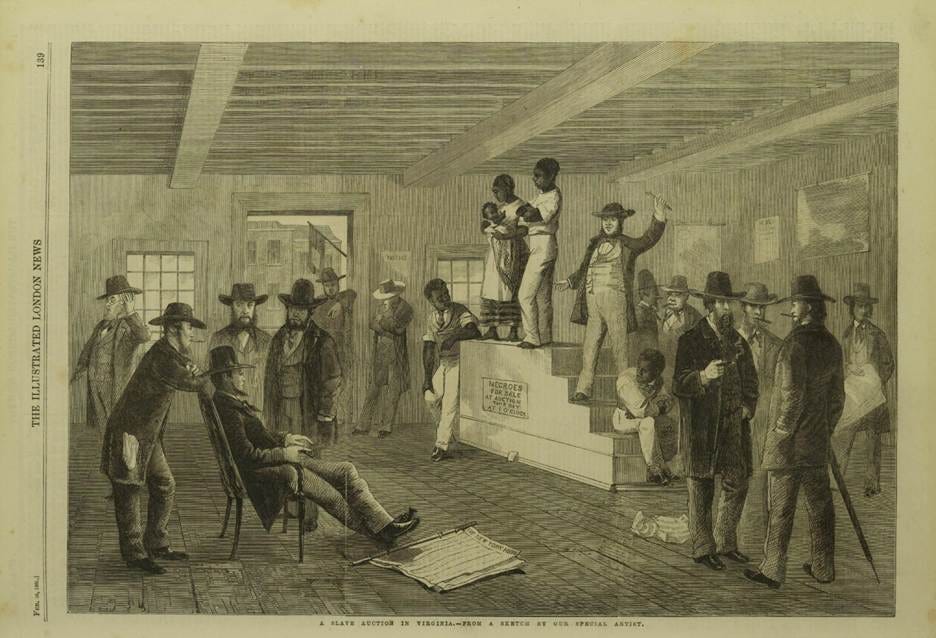
Slave auction in Virginia – Source Wikimedia
Between 1870 and 1880 a white man from Canada, Anderson Frazier, made a good living publishing pamphlets about America and its people called their “peculiarities.” The most successful series he published was related to odd aspects of life in the South, called Curiosities and Oddities about our Southern Neighbors. It was about slave owning Negroes, specifically, free Negroes who had owned other Negroes before the War between the states.
Anderson met a Negro woman Fern Elston, Henry and Caldonia Townsend’s former teacher, who also owned slaves and he related to her that Negroes owning slaves was the oddest of all the oddities he had come upon. To Anderson, it would be like owning his family, the people in his family. But to Fern, it was not the same at all. She retorqued that: “all of us do only what the law and God tell us we can do. None of us who believes in the law and God does more than that. We owned slaves. It was what was done, and so that is what we did. We, not a single one of us Negroes, would have done what we were not allowed to do. This is the truth as I know it in my heart.”
To acquire his slaves, Henry stood at the back of the slave market. A stranger might think he was waiting for his master to take him home when the market closes. But no. Using Henry’s money, Robbins the former master of Henry and his parents’, did all the purchasing of slaves. At that time, most white men knew that when they sold a slave to Robbins, they were really selling to Henry Townsend. They protested saying: who knew what a nigger really planned to do with other niggers?
In Richmond VA, there were slaves who themselves had slaves, and some of those slaves of slaves had slaves. They were all members of a free Negro class, who while not having the power of some whites, they had been brought up to believe that they were rulers waiting in the wings.
2 Slave Insurance policy sold by the Atlas Life, Casualty and Assurance Company, based in Hartford, Connecticut.
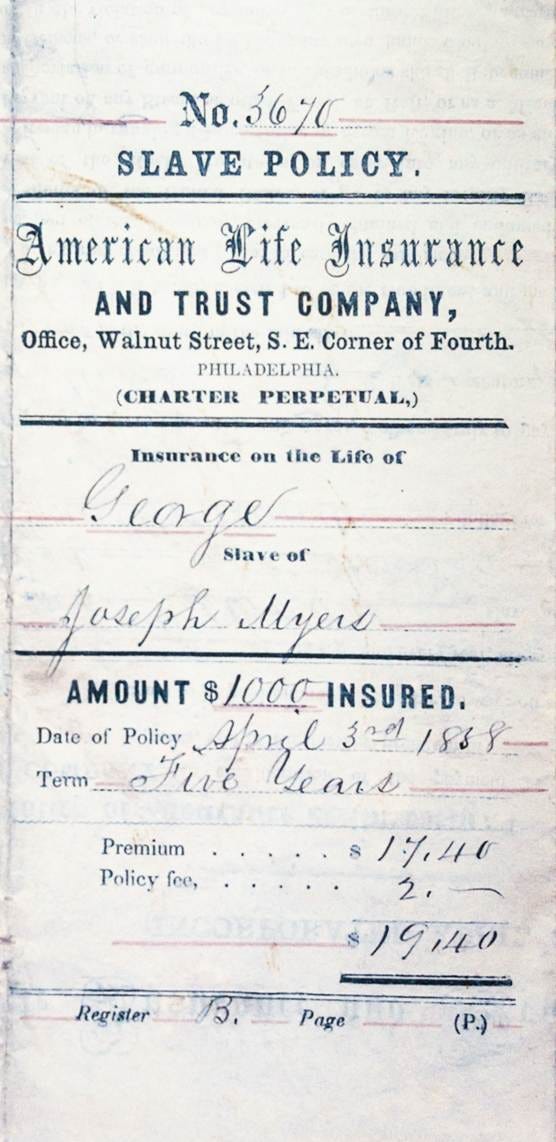
Copy of Slave insurance policy – Source Wikimedia
The details of the insurance policy they sold are as follow:
Policy for slaves injured during work:
There was a policy for a premium of 25 cents per month, which in case of the slave’s death, paid the owner the price of the slave less some % to account for depreciation due to aging.
For 15 cents a head every two months, per property each working slave over five years old, would be protected for just about everything God could think up:
Getting kicked in the head by a mule while working in the field.
Dying from tainted food – as long as a doctor could certify the food was not rancid.
Breaking a neck in a well after falling down in it while cleaning it out.
Getting bit by a snake on one foot or longer while working in the field or the barn or the smokehouse; said snake alive or dead; with suitable missing fang or fangs, would have to be produced to collect on the policy.
Slave death by mad dogs in fall, winter or spring was compensable, canine madness in the summer was an “ordinary act of God” to be expected.
Nothing comes from the loss of an arm or one or both eyes, because such losses were not the best indicia of how much work a slave could still perform.
No money for a slave hurt or killed by someone while said slave was visiting his family on another plantation.
Being struck by lightning while working in the field as long as recuperation was less than three days and as long as the slave has not been given sufficient warning that lightning was about to strike.
Death by lightning was compensable; such deaths were simply another “ordinary act of God” that the Company, in its wisdom, could not reward.
A separate policy to protect against “plain old natural death was 10 cents a head every other month. in case the policy is declined, there will be no protection on the “Perishment,” or natural death of your human property.
The word perishment had been coined by a man, who emigrated from Poland, working at the Hartford office, to convey the fragility of human life especially that of slaves.
To the Atlas agent, people who decline his offer did not know the benefits of Atlas products. A negative response was the groundwork for a positive one.
Reflection & Insights
This story is mostly about the oddities and peculiarities of America and slavery her old mistress. Guess what, you may be thinking that only whites subjected blacks to slavery but oddly as the author Edward P. Jones revealed, blacks subjected other blacks to slavery. “Black slave owners owned slaves who were slaves of slaves.”
Henry Townsend was born to slave parents who worked hard to buy themselves out of slavery. His parents had to delay buying him out of slavey because it was so expensive that they had to work years to save enough. When Henry made fortune making boots, he started acquiring slaves and ended up owning dozens of slaves.
Fern Elston who was a black teacher also owned slaves. To justify why blacks ended up owning slaves, she said that they did only what the law and God told them they could do. They owned slaves. They would not have done what they were not allowed to do.
Another odd thing was the concept of slave insurance promoted by the Atlas Life, Casualty and Assurance Company. For some fee, they were willing to insure odd things, including: getting kicked in the head by a mule, dying from tainted food, breaking a neck in a well, getting bit by a snake, or being struck by lightning.
During the antebellum period, moral and religious authorities condoned slavery and remained tight-lipped about it. The law upheld and promoted slavery. So, there was nothing wrong with owning slaves.
In Uncle Tom’s Cabin, Harriet Beecher Stowe posited that: “Perhaps you laugh too, dear reader, but you know how humanity comes out in a variety of strange forms nowadays, and there is no end to the odd things that humane people will say and do.”
So, I’d say, dear reader you may laugh or cry, but black slave owners owning slaves who were slaves of slaves is odd and it testifies of the utter oddity of human nature.
Character Growth Takeaways
Wisdom: [Scattered wisdom from the book to chew the cud]

Teaching older people (men vs women): A man does not learn very well. Women, yes, because they are used to bending with whatever wind comes along. A woman no matter the age, is always learning, always becoming. But a man stops learning at fourteen or so. He shuts it all down. A log is capable of learning more than a man. To teach a man would be a battle, a war, and I would lose.
Unusual way a white mentor (Mr. Robbins) teaches his black mentee (Henry) perseverance in life:
Mr. Robbins: Don’t settle for just a house and some land, boy. Take hold of it all. God is in heaven and he don’t care most of the time. The trick of life is to know when God does care and do all you need to do behind his back.
Henry: Yessir.
Mr. Robbins: I know you have it in you to want, to want to take hold and pull it in for yourself, don’t you. Henry?
Henry: I do Mr. Robbins.
Mr. Robbins: Then take it and let the world be damned, Henry.
Worry about rain for your garden, and don’t go any higher on the worry ladder.
The hitter can never be the judge. Only the receiver of the blow can tell you how hard it was, whether it would kill a man or make a baby just yawn.
What is fevered love?
“The love Saskia had for Thorbecke was a fevered one. Her mother said it would burn itself out if she gave it time, but Saskia disappeared with Thorbecke to Europe and the love only grew… After what happened to her in Europe, she would never love another human being in the same way.”
I’d say” If only Saskia had listened to her mother and let it burn out…
The ruin of an empire could not start with rebellion in the farthest reaches of the empire, but in the attic or bedroom or the kitchen of the emperor’s palace where he had allowed domestic chaos to fester and eventually bring down the palace, and with the palace the empire could follow.
There was a reason God had made telling the truth one of his commandments; lying had the power to be a high wall to hide all the other transgressions.
“Anything can get better on another day.”
The God of that Bible, being who he was, never gave a slave a good day without wanting something big in return.
A horse ain’t nearly as smart as a mule, the way I hear it.
A conversation about quitting smoking:
o I have never seen anything wrong with it…it is just a little habit that God don’t mind.
o If you pile up enough habits, you soon have enough for a real sin. Then you have trouble…
According to the University of Virginia historian: the Manchester County of Virginia “was torn asunder.” The historian called it “the greatest disappearance of land” in the Commonwealth.
Temperance: [Lesson about restraint, balance, humility]

The following fact illustrates some level of temperance and self-control
Sobering lesson of temperance:
Travis (police patroller in Manchester, VA county) was good at what he did and Skiffington (the Sherrif) saw him as a free-ranging cat who couldn’t be tamed but who killed enough mice to make up for his lawlessness.
Have you ever experienced such a troublemaker who you could not get rid of because you need his/her skills?
She would have sighed but that was not in her nature. Sighing was an indication of surrender, of approaching helplessness.
Courage: [Lesson about strength, risk, or standing up]

This passage depicts some level of quest for courage:
The lantern of truth: A body should be able to stand under some..some kinda light and declare what he knows without retribution. There should be some kinda lantern, that we can stand under and say, “I know what I know and what I know is God’s truth, and then come from under the light and nobody makes any big commotion bout what he said. He could say it and just get on about his business, and nobody would say: He be stickin up for nigger, he be stickin up for them Indians. The lantern of truth wouldn’t allow them to say that. There should be that kinda light.
Justice: [Lesson about fairness, integrity, or responsibility]
An act of justice from the book:
Nothing about Justice caught my attention
Memorable Quotes & Phrases
Memorable Quotes from the Book:
Moses had thought it was already a strange world that made him a slave to a white man, but God has indeed set it twirling and twisting every which way when he put black people to owning their own kin. Was even God up there attending to business anymore?
If William Robins said a storm was coming, then it did not matter how blue and pleasant the sky was and how much the chickens strutted happily about the yard.
Skiffington had learned from his father how much solace there was in separating God’s law from Caesar’s law. “Render your body unto them, but know your soul belongs to God.”
A runaway slave was, in fact, a thief since he had stolen his master’s property – himself.
I’m just a little somebody and I don’t care a bit.
The law will protect you as a master to your slave, and it will not flinch when it protects you…But the law expects you to know what is master and what is slave.
I suspect that if he had taken a beater to that suit, the dust would have been enough to engulf him.
In a world where people believe in a God they could not see and pretended the wind was his voice, paper meant nothing. It had only the power that people would give it.
The hope that more hands could wring more from the land.
Most crimes and misdemeanors by slaves were dealt with their masters; they could even hang a slave if he killed another slave, but that would have been like throwing money down a well after the salve had already thrown the first load of money down.
He was only a jackrabbit hop from …reaching the goal… the end.
The sun did not rise very high and it was only one day at a time and no one day was kin to the next.
There was a chasm and he was telling her that it was an easy thing for her to jump, that she should simply make the jump to this freedom thing that wouldn’t even include him at first.
How can you sell a free man? Outside the law…. You go outside the law.
Could the cord of a man born into slavery ever be cut forever and completely, even if he had been free for some years. Was he not doomed by virtue of the color of his skin?
I wanted to tell you somethin, and I have been working my mind so the words will tumble out in a straight line. …. Just set them words one by one and they’ll do fine and we’ll get where we got to go.
Vocabulary Builder
Words, phrases, and expressions from the book to season and spice up your language
To chew the cud: think or talk reflectively, to ponder. (literally chew partly digested food). He spent the afternoon chewing the cud over the new agreement weighing its strengths and weaknesses.
As difficult as chopping a log with a dull ax.
Something threatening was loose in the land.
Don’t go back to Egypt after God done took you outa there.
Manumit: to release from slavery
Perishment: word coined by an employee of The Atlas Life, Casualty and Assurance Company, to convey the fragility of human life especially that of slaves
Buckety-buck up: clop or jerk the way up to somewhere
Hant: ghost (U.S. southern)
Snooker: trick, trap, entice
Who Should Read This?
Anybody wishing understand another facet of America’s history with slavery